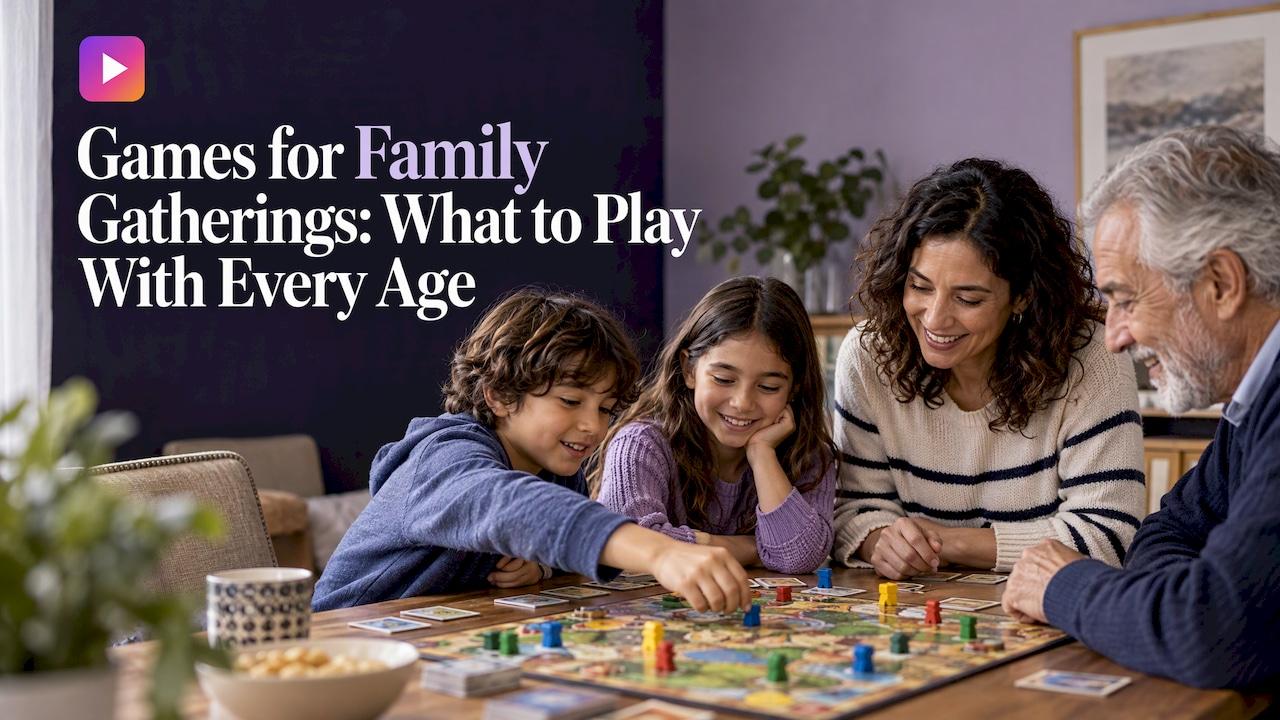
The best games for a family gathering are easy to explain, quick to play and let a seven-year-old and a seventy-year-old compete on equal terms. Think team charades, trivia, and simple card and board games, with short rounds and no one stuck waiting. When relatives live far apart, free online games with private tables bring everyone to the same game. Clearwave Games has more than 60 free card, board, puzzle, word and party games you can play online with family or solo against bots.
Below: how to pick games by group size and age, what makes a game work at a crowded table, how to run the afternoon, and how to play online safely with kids.
TL;DR
- Pick games you can teach in about 10 to 15 minutes, with rounds that run roughly 30 to 45 minutes at most.
- Match the game to the crowd: card games for small groups, trivia or drawing games for mid-size, team games for big gatherings.
- Mix ages with teams, open information and random elements so experience does not decide the winner.
- Plan a high-energy start, a calmer middle and a silly finish, and offer a seated version of everything.
- For relatives in different homes, use free online games with private tables and check chat and privacy settings first.
Table of Contents
- What makes a game work at a family gathering
- Match the game to the size of the crowd
- Games that put every age on equal footing
- Build the afternoon: an order that keeps energy right
- Playing games with relatives who are not in the room
- Keeping online play safe for kids
- Games kids can learn from
- Try it at your next gathering
- FAQ
- Sources
What makes a game work at a family gathering
A gathering is not a game night with four dedicated players. People drift in, kids wander off, and grandparents may never have touched the game. That changes what counts as a good pick.
The Guardian's panel of board-game experts says the key trait is a low barrier to entry: learnable in 10 to 15 minutes, with 30 to 45 minutes the sweet spot for play length, and flexible enough for several generations. One of them rejects anything that takes 45 minutes just to learn.
Three quick checks help you apply that:
- Setup under two minutes. Flipping a board or shuffling one deck is fine. Board Games Guide suggests a core idea explainable in 60 seconds or less, ideally with icons.
- Little reading. Count how much text a player must read per turn. If a child cannot read it, someone can read aloud, or the game goes to teams.
- No dead time. Do the wait-time math: with four players taking two-minute turns, each person watches six minutes for every two they play. Prefer games with simultaneous actions, team discussion or fast turns.
If you can, run a short practice round with the youngest player before the whole group commits. Five minutes is enough to see whether the game holds.
Match the game to the size of the crowd
Group size decides more than theme does. One party-planning guide sorts games roughly like this, and it matches how most gatherings actually go:
| Group size | What tends to work | Why |
|---|---|---|
| 4 to 6 people | Charades, Two Truths and a Lie, card games | Everyone gets frequent turns |
| 7 to 12 people | Fishbowl, trivia, telephone-style drawing | Works in teams or all at once |
| 13 or more | Family Olympics, popular-answer showdowns, carnival-style booths | Splits into stations or large teams |
For very big families, team-based word games are the safest bet. GamesRadar+'s expert list singles out one team word game as playable with 20 or more people, which avoids a free-for-all around a table.
A few specific options with their player counts and timing, from published family-game lists:
- Rummy-style and sequence card games: AARP's multigenerational list includes a five-in-a-row strategy game for 2 to 12 players and a rummy-style runs-and-sets game for ages 7 and up with 2 to 6 players.
- Drawing telephone: the same list includes a telephone-plus-drawing game for up to 12 players, which is funny precisely because nobody draws well.
- Open-space games: Mommy Poppins lists a tag-style game for ages 4 and up, 5 to 20 or more players, 10 to 20 minutes, needing only open space. A paper-and-pencil category game for teams of 2 to 4 runs about 5 minutes a round.
Games that put every age on equal footing
The hardest part of a mixed-age table is fairness. If Dad always wins, the kids quit. If a game is too simple, the adults drift off to the kitchen. Four design choices fix most of this.

Teams. Pair a child with an adult. Board Games Guide's mixed-age advice is that team play is the most reliable way to seat a strong and weak player together: the child makes the choice while the adult handles the reading or arithmetic. Agree who does what before the round starts.
Open information. Cooperative games where everyone sees the same cards are the lowest-friction option across wide age gaps. Hidden-role games depend on secrets that a young child may not keep straight.
Luck. A dash of randomness means the most experienced player is not guaranteed to win. Dice, spinners and bonus rounds do this well.
Flexibility. Parents.com suggests adapting rules for younger children, such as playing a solo word game as a partner game for pre-readers, and choosing cooperative games for kids who struggle with losing.
For non-readers, one wide-age-range guide suggests reading questions aloud, accepting spoken answers, or letting a child point to a choice. A trivia relay can run with ages 6 to 80 if the questions span topics, so each generation owns a category.
Build the afternoon: an order that keeps energy right
A gathering usually has a rhythm. One party guide recommends starting high-energy, then quiet, then silly, with each round under 10 minutes when ages are mixed. A family reunion sequence shows how this plays out:
- Icebreaker in small mixed-age groups. A "find what you have in common" game needs no materials and fits 4 to 40 people in 10 to 20 minutes.
- Team charades as the main event. It runs 20 to 45 minutes for 4 to 20 players.
- A seated drawing game. Pairing a grandparent with a grandchild tends to be the most memorable moment, and it lets those who do not want to run around stay involved.
- A one-word-at-a-time story. Even the youngest reader can add a word, and it works in 5 to 20 minutes.
The same guide advises offering every game in a seated version without being asked. Nobody should have to announce that they cannot do the active round.
Playing games with relatives who are not in the room
Many families now have a cousin in another state or grandparents a few time zones away. Online games let them join the same table. The same rules apply: short rounds, simple rules, a chance for every age to win.
This is where we fit. Clearwave Games offers more than 60 free games, including popular Middle-Eastern card games and classic board games, and you can play online with friends or family or solo against bots. Customizable rules let you tune a game to your family's house rules, and server-managed fair play keeps the shuffle honest, so no one wonders about the deal. Because bots fill in, a kid can learn the rules alone before joining the grown-ups.
Practical points for an online family session:
- Agree on a time and a game in advance. A group text with the table or lobby details saves the usual "how do I join?" scramble.
- Choose card, board, word or puzzle games for the video call. They need little explanation and work well when someone is on a phone.
- Keep rounds short. The same 10 to 15 minute teaching rule applies, and screens tire kids faster than a table does.
- Use bots for the gaps. If one relative is late or a sixth person drops out, a bot keeps the game going.
Keeping online play safe for kids
Most family games work best in the same room. When you play with extended family online, a few checks matter. Screenwise advises understanding privacy settings and who can communicate with your children, and using private lobbies for family play.
The ESRB, the US video game ratings board, labels games with age ratings and also lists "interactive elements": whether users can interact with each other, share location, make in-game purchases or access the open internet. Check those labels before a child joins a game, and use the parental controls on the device as well.
A simple routine before the first game:
- Read the age rating and the interactive-elements label.
- Set up a private table so only invited relatives can join.
- Decide whether chat is on, and who the child may talk to.
- Sit with younger players for the first game, so you see how it works.
Games kids can learn from
Most family games teach something without trying. Word games build spelling and vocabulary, card games build counting and pattern recognition, and strategy board games exercise planning. Trivia relays let a child show off what they know. Team formats add turn-taking and talking things through.
For younger children who need more structure, Owl Buddy Worlds is our ad-free children's learning app. It offers school lessons, interactive activities, offline access and printable worksheets, so it works in the car on the way to the gathering or at a relative's house without Wi-Fi. We have not published a price for it.
If your family likes games that get everyone off the sofa, MoveVerse uses your phone's camera for motion-controlled games, so you need no extra hardware.
Try it at your next gathering
For a gathering with a mix of ages, start with a short card or board game on Clearwave Games. You can play against bots first to learn the rules, then set up a table for the family, and every game is free. Open Clearwave Games in your browser or on Android and pick something with rules you can explain in a minute.

For more ideas on picking games for the table, see our guide to family game night games.
FAQ
What is a good game to play with a family?
Choose one you can teach in 10 to 15 minutes, with rounds of 30 to 45 minutes or less. Team charades, trivia, simple card games and drawing games all meet that bar. Pick whichever matches your group size, and let kids team up with adults.
How do you make a family gathering more fun?
Plan a rhythm: a lively opener, a team game as the main event, and a calm seated game. Keep each round under 10 minutes for mixed ages, offer every game in a seated form, and mix generations on the same team.
What are good games for a large family?
Go for team-based games and stations. Team word games can work with 20 or more players, and family Olympics or carnival-style booths suit 13 or more. Split into teams so no one waits long for a turn.
Can we play family games online with relatives far away?
Yes. Pick a free card, board or word game, agree on a time, and use a private table so only invited relatives join. Clearwave Games has more than 60 free games you can play online with family, and bots can fill empty seats.
Sources
- The Guardian: The 25 best family board games in the US
- Board Games Guide: 10 tips for finding family party games
- Board Games Guide: Choosing games for a mixed-age family table
- Epic Party Pop: Family party games
- GamesRadar+: Best family board games
- AARP: 11 games the whole family can enjoy
- Mommy Poppins: Group games kids of all ages can play together
- Parents.com: The best family games
- Party Whammy: Party games for a wide age range
- Gather & Play: Family reunion games
- Screenwise: Multiplayer games for the family
- ESRB: Ratings and tools for parents